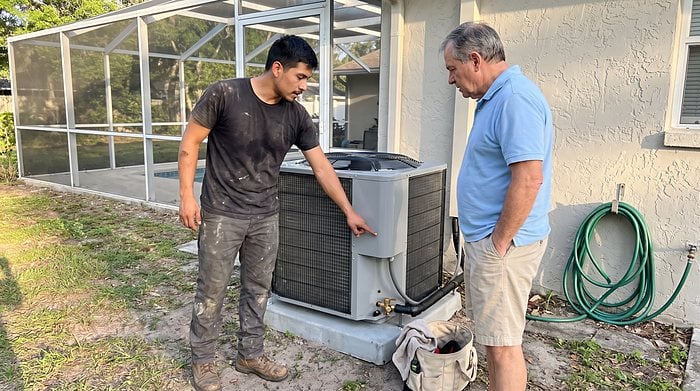
When you hire an HVAC contractor in Orlando, you are trusting them with more than the air conditioner itself. Installation involves refrigerant handling, electrical connections, equipment sizing, ductwork, and Florida-specific licensing requirements, much of which you will never see once the job is complete.
The right credentials give you a way to verify who is legally qualified to perform the work and what technical training they have. This guide explains the key HVAC credentials Orlando homeowners should look for, what each one actually means, and how to verify them before hiring a contractor.
Florida Certified Class A Air Conditioning Contractor (CAC)
This is the one that is not optional. Air conditioning contracting in Florida is regulated under Chapter 489 of the Florida Statutes, and licenses are issued by the Construction Industry Licensing Board within the Department of Business and Professional Regulation.
A Class A certified air conditioning contractor can install, service and repair equipment of any size, with no cap on tonnage or BTU capacity, anywhere in the state. For a house in Orlando that ceiling rarely matters. The word "certified" does.
Certified means the contractor passed the state examination and holds a license valid statewide. The alternative was a registered license, issued locally and valid only in that jurisdiction. House Bill 735 changed that on July 1, 2025, preempting local licensing and moving contractors toward state-issued certified licenses.
Getting there is not quick. An applicant must:
- Show qualifying experience in the trade
- Pass a trade knowledge exam and a separate business and finance exam
- Clear a criminal background check
- Demonstrate financial stability and responsibility
- Carry liability and property damage insurance, plus workers' compensation where employees are involved
A certified license number begins with CAC, in the format CAC1815432. Under Florida Statute 489.119 it must appear in every proposal, bid, contract and advertisement the company issues. If you cannot find it on an estimate, a website or a truck, the absence is itself informative.
Florida Class B Air Conditioning Contractor (CBC)
A Class B license covers the same trade with a capacity limit: cooling under 25 tons and heating under 500,000 BTU per hour per unit. Like Class A, it is a state certification valid anywhere in Florida.
For a typical Orlando home that ceiling is academic. Even a large house usually runs a five ton system, well inside the limit, so a Class B contractor is fully licensed for the work. The distinction matters if you own a small commercial property or a multi-unit building.
Class B is not a lesser credential for residential work. What is worth confirming is that the license is current and genuinely held by the company doing your installation, rather than borrowed from a qualifying agent who will never appear on your property.
EPA Section 608 Technician Certification
This one is federal, and it attaches to the technician rather than the company. Under Section 608 of the Clean Air Act, anyone opening a refrigerant circuit must be certified, and certification is a precondition for legally buying refrigerant at all.
There is no way around it. An uncertified technician cannot purchase the R-410A or R-454B your system runs on. The certification comes in four forms.
Type I: Small Appliances
Covers factory-sealed systems holding five pounds of refrigerant or less: window units, PTACs and domestic refrigerators. Not sufficient for a central system.
Type II: High-Pressure Systems
Covers high and very high pressure equipment, which is essentially every residential and light commercial split system and heat pump. This is the type that matters for an Orlando home.
Type III: Low-Pressure Systems
Covers low-pressure equipment such as large commercial chillers. Relevant to a hotel or an office tower rather than a house.
Universal: All Three Categories
Awarded to a technician who passes Core plus all three type sections. It is the one worth asking about, since it means qualification across every category of equipment rather than one.
Two details deserve attention. Every candidate must pass Core before any certification is issued, and the certification never expires, with no renewal or continuing education required. A 608 card therefore proves a technician was qualified on the day they passed, and says nothing about the years since, which is why it should sit alongside a credential that does expire.
NATE Certification
NATE, North American Technician Excellence, is that credential, and the expiry is the point of it.
It is voluntary, awarded to individual technicians rather than companies, and earned by examination. The traditional route is a Core exam plus a specialty exam. There is also the CHP-5 pathway: five exams covering HVAC fundamentals, electrical and controls, comfort and airflow, installation, and service.
Specialties divide into installation and service tracks. Installation covers setting up and starting new equipment correctly, while service covers diagnostics and troubleshooting on systems already in place. Which track is relevant depends on what you are hiring for.
NATE certification lasts two years. Recertifying requires 16 continuing education hours plus a renewal fee, or retaking the specialty exam. Miss the deadline by more than 120 days and the technician must pass an entire pathway again.
That is what gives it weight. A state license proves the company is authorized and a 608 card proves a technician passed an exam at some point. NATE indicates someone has stayed current within the last two years, which in a trade where refrigerants and efficiency standards keep changing is not a small distinction.
ACCA Membership
ACCA, the Air Conditioning Contractors of America, is a trade association rather than a licensing body, so membership is not a qualification. What it signals is which standards a company designs to.
ACCA publishes the ANSI-approved manuals defining how residential systems should be engineered:
- Manual J calculates the actual load of your specific house, accounting for insulation, windows, orientation and air sealing
- Manual S selects equipment sized to that calculated load rather than to whatever tonnage was there before
- Manual D designs the duct system to deliver the airflow the selected equipment requires
- Manual T covers air distribution and register selection room by room
Those four separate an installation engineered for your house from one that swapped a box for a similar box. In Florida humidity an oversized system is especially costly, because it cools quickly, satisfies the thermostat and shuts off before running long enough to pull moisture out. A proper load calculation before replacement is worth asking about by name.
BBB Accreditation and an A+ Rating
BBB accreditation is not a technical credential and should not be read as one. It reflects how a company handles complaints, advertising claims and disputes rather than how well it installs equipment.
That still tells you something. Accreditation requires meeting BBB standards and continuing to meet them, and the rating reflects complaint history and resolution. An A+ indicates a record of responding to problems.
Read it alongside review volume rather than instead of it. A 5-star rating across 47 Google reviews is a different signal from a 4.9 across 1,200, and both differ from an A+ with no reviews at all. You are looking for consistency across independent sources, not one impressive number.
Proof of Insurance and a Clean Disciplinary Record
Licensing requires insurance at application. It does not prove coverage is still in force today, which is why these are worth confirming separately before anyone opens a panel in your home.
- General liability coverage, current, and naming the company actually doing the work
- Workers' compensation, which matters most if a technician is injured on your property
- Property damage coverage, since this work happens near drywall, ceilings and electrical
- A disciplinary history search on the license, not merely confirmation that one exists
- Confirmation that the license holder is genuinely affiliated with the company you hired
The fourth is the one homeowners skip. A license can be active and still carry prior complaints or disciplinary action, and the DBPR record shows both. A contractor with no violations on file has a verifiable record rather than a marketing claim, which matters as much for a same-day AC repair call as for a full installation.
Which Credentials Matter Most: How Do They Compare?
Not every credential answers the same question. A contractor license establishes whether a company can legally perform the work, while technician certifications show individual training or technical knowledge. Business credentials, meanwhile, can provide additional information about how the company operates.
| Credential | Who Holds It | What It Helps Verify |
|---|---|---|
| Florida CAC or CBC license | Contractor/company | Legal authorization to perform covered HVAC contracting work |
| EPA Section 608 | Individual technician | Qualification to handle regulated refrigerants |
| NATE certification | Individual technician | Tested HVAC technical knowledge in specific specialties |
| ACCA membership | Company | Participation in an HVAC industry organization and access to industry standards |
| BBB accreditation | Company | Business practices and participation in BBB's standards |
| Insurance | Company | Financial protection associated with covered claims or property damage |
The most important distinction is between company credentials and technician credentials. A company may hold the required Florida contractor license while the technician arriving at your home holds separate certifications such as EPA Section 608 or NATE.
That is why asking, "What license does your company hold?" and "Which certifications does the technician performing my work hold?" gives you more useful information than simply asking whether the company is "certified."
How to Verify an Orlando HVAC Contractor in Ten Minutes
You do not have to rely entirely on an HVAC company's website when checking credentials. Florida license information can be verified through the state's licensing database, while business credentials and technician certifications can be checked separately.
| What to Check | Where to Verify It |
|---|---|
| Florida contractor license and status | MyFloridaLicense.com |
| License classification | Florida DBPR license record |
| Disciplinary information | Florida DBPR license record, where available |
| License number used in advertising | Company website, estimate, vehicle, and other business materials |
| BBB accreditation | BBB.org |
| Recent customer experiences | Company's current Google Business Profile |
| EPA Section 608 certification | Ask the technician or company for verification |
| NATE certification | Ask which technicians are NATE-certified and what specialty they hold |
Start with the Florida contractor license, because that establishes whether the business has the appropriate state credential for the HVAC contracting work it performs. Then verify the individual technician's credentials if certifications such as EPA Section 608 or NATE are advertised.
Before signing an estimate, it is also reasonable to confirm that the license information on the proposal matches the contractor record. Taking a few minutes to verify these details can help you understand exactly who is responsible for the work and what qualifications apply.
FAQs
Does an Orlando HVAC Contractor Need a Florida License?
Yes. A contractor performing regulated HVAC work in Florida generally needs the appropriate state or local contractor licensing. Homeowners should verify the contractor's license status through the Florida DBPR before hiring.
What Is EPA Section 608 Certification?
EPA Section 608 certification is required for technicians who service equipment containing regulated refrigerants. It demonstrates that the technician has been tested on proper refrigerant handling, recovery, and environmental requirements.
Is NATE Certification Required for Orlando HVAC Technicians?
NATE certification is not the same as a Florida contractor license and is not required for every HVAC technician. It is an industry credential that demonstrates tested technical knowledge in specific HVAC areas.
What Is the Difference Between a Florida HVAC License and EPA 608 Certification?
A Florida HVAC license applies to the contractor's legal authority to perform contracting work, while EPA Section 608 applies to an individual's ability to handle regulated refrigerants. They serve different purposes and should not be treated as interchangeable credentials.
How Can I Verify an Orlando HVAC Contractor's Credentials?
Start by checking the contractor's Florida license through the state's license verification system. You can also ask which technicians will perform the work and request documentation for credentials such as EPA Section 608 or NATE certification.
Why Orlando Homeowners Check Credentials Before Calling Jormechanical Air
Credentials are the part of this decision you can confirm before committing to anything, which is why they deserve ten minutes rather than a glance at a logo.
Jormechanical Air holds Florida Certified Air Conditioning Contractor license CAC1821345, Class B. Our HVAC technicians hold EPA 608 certification, and the BBB has rated us A+ since April 2025. Search the license number on myfloridalicense.com, and you'll see the record for yourself.
Those sit in different categories deliberately. The license is the legal requirement, the 608 credentials belong to the technicians in your house, and the BBB and review record to what happens if something needs sorting out afterward.
If you are comparing quotes, run these checks on every company on your list rather than only the one you are leaning toward. Ask what an AC installation and replacement quote includes, ask what a seasonal maintenance agreement covers, and ask who specifically will do the work. A contractor confident in their credentials will not mind any of it